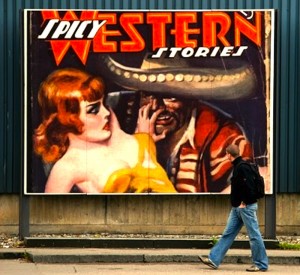
An illustrated lecture with William Nericcio, PhD (reloaded)
Date: April 12, 2013
Time: 8:00 p.m.
Admission: $8
Presented by: Borderline Projects
After a forced delay due to Hurricane Sandy, William Nericcio is finally coming to New York City to share his confessions with us at Observatory. What happens to the mind of a relatively sane Mexican American academic when plunged into the laughter of an East Coast undergraduate student? What madness ensues once that self-same “scholar” uses his academic superpowers to catalogue Mexican stereotypes in the United States? What happens! Mextasy! Enter the Observatory tonight for a brief MEXSTATIC multimedia presentation examining dominant trends in the 21st century representation of Latinas and Latinos in American popular culture. From Hollywood to Madison Avenue, specific and damaging visions of Latina/o subjectivity have infected the synapses of Americans, and Mexicans alike. These “ethnic mannequins” (William Levy, Eva Longoria, Sophia Vergara) work to infect consciousness even as they entertain, and are not utterly divorced from what’s going down contemporaneously: a talk-radio fueled renaissance on racialized hatred currently en vogue in the U.S. from New York to California, from Arizona to Georgia. If Lou Dobbs spews out that Mexicans are “diseased,” and Rush Limbaugh tells his listeners to tell “Mexicans” to go back to “their country,” what is the result? Research would seem to suggest these collective efforts have led to a resurgence of anti-Latino hate and hate crimes at the very moment demographically that the lands of Uncle Sam are more decidedly Latino/a. The presentation will feature excerpts from Tex[t]-Mex, Eyegiene, the Tex[t]-Mex Galleryblog and art from Mextasy.
William Nericcio, born in 1961 at Mercy Hospital, Laredo, Texas, is Professor of English and Comparative Literature at San Diego State University where he directs M.A.L.A.S, the Master of Arts in Liberal Arts and Sciences program, an eclectic West Coast cultural studies hive. A 1980 graduate of St. Augustine High School (where he somehow survived being “raised by nuns”), Nericcio graduated with a degree in English from the University of Texas at Austin in 1984 and completed his MA (1987) and PhD (1989) in Comparative Literature at Cornell University—among other noteworthy mentors there, Nericcio TAed for Carlos Fuentes, and studied with Henry Louis Gates, Jr., Gayatri Chakravorty Spivak, and Enrico Mario Santí. Nericcio is the author of Tex[t]-Mex: Seductive Hallucination of the “Mexican” in America (UT Press, 2007), and is in the final stages of writing his next eye-candy filled study, Eyegiene: Permutations of Subjectivity in the Televisual Age of Sex and Race, also with the UT Press.
 Date: Sunday, April 14 Date: Sunday, April 14
Time: 12 – 6 PM
Admission: $350
***Class Limited to 5; Must RSVP to katie.innamorato [at] gmail.com
This class is part of The Morbid Anatomy Art Academy
This course will introduce students to basic and fundamental taxidermy techniques and procedures. Students will be working with donated raccoon skins and will be going through the steps to do a head mount. The class is only available to 5 students, allowing for more one on one interaction and assistance. Students will be working with tanned and lightly prepped skin; there will be no skinning of the animals in class. This is a great opportunity to learn the basic steps to small and large mammal taxidermy. All materials will be supplied by the instructor, and you will leave class with your own raccoon head mount.
Rogue taxidermist Katie Innamorato has a BFA in sculpture from SUNY New Paltz, has been featured on the hit TV show “Oddities,” and has had her work featured at La Luz de Jesus gallery in Los Angeles, California. She is self and professionally taught, and has won multiple first place ribbons and awards at the Garden State Taxidermy Association Competition. Her work is focussed on displaying the cyclical connection between life and death and growth and decomposition. Katie is a member of the Minnesota Association of Rogue Taxidermists, and with all M.A.R.T. members she adheres to strict ethical guidelines when acquiring specimens and uses roadkill, scrap, and donated skins to create mounts.
Her website and blogs-
www.afterlifeanatomy.com
www.afterlifeanatomy.tumblr.com
www.facebook.com/afterlifeanatomy
www.etsy.com/shop/afterlifeanatomy
 Portrait of Myra Basey by Shannon Taggart Date: Thursday, April 4th
Time: 8 pm
Admission: $10
Presented by: Shannon Taggart
Myra Basey, a Spiritualist medium visiting from the UK, will conduct a traditional Spiritualist message service and demonstration of clairvoyance. A brief introduction to Spiritualism and message services in general will also be included. This is a rare opportunity - hope to see you there!
About the presenter – From early childhood Myra Basey has communicated with spirits and has had distinct memories of a past life. These surfaced spontaneously and contained memories of places and specific situations and events. As well as travelling America and Canada, lecturing, training and holding workshops and discussion groups, Myra has worked all over the UK, spending a number of years in residency at the Spiritualist Association of Great Britain in London.
 Transmission from Elvis by Myra Basey, photo by Shannon Taggart Date: Saturday, April 6th
Time: 2 pm
Admission: $10
Presented by: Shannon Taggart
Automatic writing (or psychography) is writing which the writer claims to be produced from a subconscious, external or spiritual source without conscious awareness of the content. Automatism, the cornerstone of Surrealism, was co-opted from Spiritualism’s use of automation as a technique to create without conscious self-censorship. The automatic writing and drawing practiced by the Surrealists can be compared to methods used in other artistic efforts such as actionist painting and the improvisation of free jazz.
During this presentation, Myra Basey, a Spiritualist medium visiting from the UK, will demonstrate her unique form of automatic writing. A stripped down fountain pen is propped against the clenched fist of her left hand (although she is right handed) to produce writing. The messages make complete sense and every word can be read clearly. She works with two specific spirits, one of whom she identifies as Elvis Presley. Since 1977 she has written thousands of transmissions from Elvis.
A brief overview of automatic writing will be presented. Myra will talk about the mechanics of physical mediumship and automatic writing as well as share what she has learned from years of practice. There will be a question and answer session for those interested in pursuing the automatic writing process and those curious about Spiritualism and psychic matters.
About the presenter - From early childhood Myra Basey has communicated with spirits and has had distinct memories of a past life. These surfaced spontaneously and contained memories of places and specific situations and events. As well as travelling America and Canada, lecturing, training and holding workshops and discussion groups, Myra has worked all over the UK, spending a number of years in residency at the Spiritualist Association of Great Britain in London.
 Illustrated Lecture with Matthew Wittmann, Curatorial Fellow at the Bard Graduate Center and author of Circus and the City: New York, 1793-2010 Illustrated Lecture with Matthew Wittmann, Curatorial Fellow at the Bard Graduate Center and author of Circus and the City: New York, 1793-2010
Date: Tuesday, March 19
Time: 8:00 PM
Admission: $8
Presented by Morbid Anatomy
Charles Sherwood Stratton (1838-1883), better know to the world as General Tom Thumb, was a dwarf, an entertainer, and one of the most famous Americans of the 19th century. His success in the United States transformed the traditional exhibition of lusus naturae, or human wonders, into a flourishing commercial industry. This presentation explores what made the diminutive General such a sensation and traces his fascinating career from the boards of Barnum’s American Museum through his celebrated tour around the world.
Matthew Wittmann is a Curatorial Fellow at the Bard Graduate Center, the author of Circus and the City: New York, 1793-2010 (BGC, 2012) and co-editor of The American Circus (Yale, 2012). He is a graduate of the Program in American Culture at the University of Michigan and is working on projects that range from popular entertainment to Pacific history. He blogs about these assorted interests at www.matthewwittmann.com
 Image courtesy Audubon Nature Institute An illustrated lecture by journalist Emily Anthes
Date: Friday, March 29
Time: 8 PM
Admission: $10 – copies of Frankenstein’s Cat will be available for purchase and signing
Biotechnology has given us a whole new toolbox for tinkering with life, and we have the power to modify animals in profound new ways. We are editing their genetic codes, rebuilding their broken bodies, and supplementing their natural senses. Scientists have already created all sorts of strange creatures, including a glow-in-the-dark cat, a bionic bulldog, and a remote-controlled cyborg beetle.
In this talk, journalist Emily Anthes, author of the new book Frankenstein’s Cat, takes us from petri dish to pet store as she explores how biotechnology is shaping the future of our furry and feathered friends. Though our new scientific superpowers often spur apocalyptic fantasizing, they could do more good for animals that they’re often given credit for.
Anthes will discuss how we can harness advances in genetics, neuroscience, and electronics to create healthier, happier, fitter critters. If we’re thoughtful and careful, we may just be able to use biotechnology to save animals—and ourselves.
A Q&A will follow the presentation.
This event is part of CUT/PASTE/GROW.
 With Bess Lovejoy, author of Rest in Pieces With Bess Lovejoy, author of Rest in Pieces
Date: Friday, April 26th
Time: 8pm
Admission: $10
Presented by Morbid Anatomy & Phantasmaphile
Most of us know what our afterlives are going to be like: eternity in the ground, or resting in an urn on some relative’s mantelpiece. If we’re lucky, our children might occasionally bring us flowers or a potted plant, and that’s about as interesting as things are going to get.
Not so the famous deceased. For millennia, they’ve been bought and sold, worshipped and reviled, studied, collected, stolen, and dissected. They’ve been the star attractions at museums and churches, and used to found cemeteries, cities, even empires. Pieces of them have languished in libraries and universities, in coolers inside closets, and in suitcases underneath beds. For them, eternity has been anything but easy.
The more notable or notorious the body, the more likely it is that someone’s tried to disturb it. Consider the near-snatching of Abraham Lincoln, or the attempt on Elvis’s tomb. Then there’s Descartes, who is missing his head, and Galileo, who is spending eternity without his middle finger. Napoleon’s missing something a bit lower, as is the Russian mystic Rasputin, at least if the rumors are true. Meanwhile, Jesse James has had three graves, and may not have been in any of them, while it took a court case and an exhumation to prove that Lee Harvey Oswald was in his.
In this illustrated lecture, Bess Lovejoy will draw on her new book, Rest in Pieces, to discuss the many threats faced by famous corpses-from furta sacra (“holy theft” of saintly relics), to skull-stealing phrenologists, “Resurrection Men” digging up cadavers for medical schools, modern organ harvesters, the depredations of crazed fans, and much more.
Rest in Pieces will also be available for sale, and wine will be served in celebration of its release.
Bess Lovejoy is a writer, researcher, and editor based in Seattle. She writes about dead people, forgotten history, and sometimes art, literature, and science. Her writing has appeared in The New York Times, The Believer, The Boston Globe, The Stranger, and other publications. She worked on the Schott’s Almanac series for five years. Visit her at BessLovejoy.com.
 Austin Osman Spare “The Death Posture” 1913 With Robert Ansell of Fulgur Esoterica
Date: Tuesday, April 2nd
Time: 8pm
Admission: $10
Presented by Phantasmaphile
Austin Osman Spare was an English occult artist working in the early-to-mid 20th Century. An exceptional illustrator and painter, he also developed his own mystical practice involving sigils and other esoteric codification. In this 60min audio-visual journey, we are invited to explore Austin Spare’s approach to creating magical art. His liminal methods are then compared with classical composers working during his lifetime. There is also a soundtrack by John Contreras (of Current 93 and Baby Dee) that was composed uniquely for this presentation.
This talk will be immediately followed by the US launch celebration of Issue 3 of Abraxas International Journal of Esoteric Studies. Copies will be available for sale - save on international shipping! - and wine will be served.
Robert Ansell is the managing director of the highly-regarded publishers FULGUR. For more than 20 years he has collaborated with writers and artists, both established and new, to produce some of the most inspirational magical books of recent times. In 2009 Robert launched Abraxas, a high quality journal of esoteric studies that has been widely lauded.
A specialist in the art and sorcery of Austin Osman Spare, his published work includes; AOS Ex-Libris (1988), The Book of Ugly Ecstasy (1996), Borough Satyr (2005), The Valley of Fear (2008), The Exhibition Catalogues of Austin O. Spare (2011) and The Focus of Life (2012). In 2010 he was also interviewed on Austin Spare for the BBC Culture Show. Though rarely seen as a public lecturer, his two recent appearances concerning Spare, AOS: A Celebration (2006) and The Cult of One (2007) received critical acclaim.
 Taxidermied mouse from the Senckenberg Museum, Frankfurt, Germany Date: Saturday, March 30
Time: 1-5 PM
Admission: $110
***Please note: This class will be held offsite at Acme Studio : 63 N. 3rd Street, Williamsburg, Brooklyn
Advance Tickets Required; Click here to purchase.
Class limit: 10
This class is part of the Morbid Anatomy Art Academy
The natural world has long captivated human kind, and taxidermy has played a large role in our understanding and study of animals; the painstaking creation of life-like mounts take much attention and research, and requires and builds a deep appreciation of nature.
In this class, Divya Anantharaman-who learned her craft under the tutelage of famed Observatory instructor Sue Jeiven-will lead students in an investigation into the humble mouse. Students will create a fully finished classic mount of a mouse, on a base and in the natural setting of their choice. Students will learn everything involved in producing a finished mount, from initial preparation, hygiene and sanitary measures, fleshing, tail stripping, and dry preservation. The use of anatomical study, reference photos, and detailed observation will also be reviewed as important tools in recreating the nuanced poses and expressions that magically reanimate a specimen. Students are welcome to bring their own bases and accessories if something specific is desired. All other supplies will be provided for use in class.
Each student will leave class with a fully finished piece, and the knowledge to create their own pieces in the future.
Divya Anantharaman is a Brooklyn based artist whose taxidermy practice was sparked by a lifelong fascination with natural mythology and everyday oddities. After a journey filled with trial and error, numerous books, and an inspiring class (Sue Jeiven’s popular Anthropomorphic Mouse Taxidermy Class at Observatory!), she has found her calling in creating sickly sweet and sparkly critters. Beginning with mice and sparrows, her menagerie grew to include domestic cats, woodchucks, and deer. Recently profiled on Vice Fringes, the New York Observer, and other publications, she will also be appearing in the upcoming season of Oddities-and is definitely up to no good shenanigans. You can find out more at www.d-i-v-y-a.com
Also, some technical notes:
- We use NO harsh or dangerous chemicals.
- Everyone will be provided with gloves.
- All animals are disease free.
- Although there will not be a lot of blood or gore, a strong constitution is necessary; taxidermy is not for everyone
- All animals were already dead, nothing was killed for this class.
- Please do not bring any dead animals with you to the class.
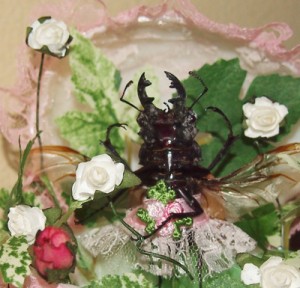 With Daisy Tainton, Former Senior Insect Preparator at the American Museum of Natural History With Daisy Tainton, Former Senior Insect Preparator at the American Museum of Natural History
Date: Sunday, March 17th (Special Easter/Spring Edition!)
Time: 1 – 4 PM
Admission: $65
***Tickets MUST be pre-odered by clicking here
This class is part of The Morbid Anatomy Art Academy
For this special edition, vintage egg displays will be available along with regular wooden shadowboxes of various shapes and sizes. Want something? Bring it! My selection is random!
1:18 scale is best when shopping for miniatures.
BEETLES WILL BE PROVIDED. Each student receives one beetle approximately 2-3 inches tall when posed vertically.
Today, join former AMNH Senior Insect Preparator Daisy Tainton for a special Easter/Spring-themed edition of Observatory’s popular Anthropomorphic Insect Shadowbox Workshop. In this class, students will work with Rhinoceros beetles: nature’s tiny giants. Each student will learn to make–and leave with their own!–shadowbox dioramas featuring carefully positioned beetles doing nearly anything you can imagine. A collection of miscellaneous dollhouse toys will be provided to finish your diorama.
Daisy Tainton was formerly Senior Insect Preparator at the American Museum of Natural History, and has been working with insects professionally for several years. Eventually her fascination with insects and love of Japanese miniature food items naturally came together, resulting in cute and ridiculous museum-inspired yet utterly unrealistic dioramas. Beetles at the dentist? Beetles eating pie and knitting sweaters? Even beetles on the toilet? Why not?
|